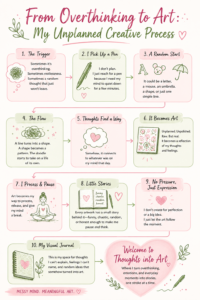
I rarely sit down to create art with a master plan. Most days, I make art simply because I need to. Sometimes I’m overthinking, sometimes I’m restless, and other times, a random, stubborn thought gets stuck in my head – refusing to leave until I let it out. There are days when I pick up a pen for the simplest reason: I want my mind to quiet down.
That’s exactly how Thoughts into Art was born.
Unfiltered, Unpolished, and Unplanned
The art I’m making now isn’t meant to be pristine or perfectly curated. It doesn’t always carry a profound or heavy metaphor. Instead, it’s a living reaction to the moment.
A single letter might spin out into an intricate pattern. A steady, simple line can morph into a beautifully chaotic design. A fleeting thought finds its way into a doodle.
I might start with something as ordinary as a mouse, an umbrella, a geometric shape, or just a single character on the page. But before I know it, I’m deep into a drawing that feels surprisingly connected to whatever headspace I was in that day.
For me, art has slowly become the ultimate way to process the world.
Redefining the Overthinker’s Mind
I’ve always been an overthinker. My mind loves to take the tiniest thought and build an entire universe around it. For a long time, I saw this as a flaw. I thought I needed to fix it, to quiet it, to stop overthinking altogether.
Now, I’m trying something different. Instead of fighting the noise, I’m giving those thoughts a place to go – a page.
Thoughts into Art is my visual journal of that experiment.
Each piece tells its own micro-story. Some are lighthearted and funny. Some are chaotic. Many are random. And a few are honest enough to make me pause and really look at myself.
I never sit down with the goal of creating something “deep.” Most pieces start with the everyday realities of being human – a sudden craving, a passing mood, a nostalgia-heavy memory, or a dramatic conversation happening entirely in my head. The art just follows the story. I use lines, patterns, textures, and shapes to anchor those floating, invisible moments into something real.
The Power of the Messy Page
I’ve realized that art doesn’t have to be perfect to be meaningful. In fact, a messy, unplanned, impulsive drawing often reveals more about a person’s true state of mind than a pristine, heavily calculated illustration ever could.
This space is dedicated to that raw transition:
For the thoughts I couldn’t quite put into words. For the feelings I didn’t know how to name. And for the completely random ideas that somehow, against the odds, turn into art.
Welcome to Thoughts into Art – a space where I turn overthinking, raw emotions, and everyday moments into visual stories, one stroke at a time.
FAQ’s
1. What exactly is Thoughts into Art?
Thoughts into Art is my visual journal and creative experiment. It is a dedicated space where I take my tendency to overthink, my daily emotions, and random everyday moments, and translate them into raw, unplanned drawings, doodles, and patterns.
2. Do you plan your artwork before you start drawing?
Rarely. My creative process is highly intuitive and spontaneous. I usually start with something incredibly simple—like a single letter, a basic geometric shape, or an everyday object like an umbrella—and let the lines and patterns evolve naturally based on whatever is on my mind that day.
3. Does every piece of art have a deep or profound meaning?
Not at all. While a few pieces are deeply honest and reflective, many start from very ordinary, lighthearted places. A piece might be inspired by a sudden food craving, a passing mood, a random memory, or even a chaotic, imaginary conversation happening in my head.
4. I’m an overthinker too. Can art really help quiet a loud mind?
For me, absolutely. I used to view my overthinking as a flaw that I needed to “fix” or suppress. Thoughts into Art began because I decided to stop fighting the mental noise and instead give it a physical place to go. Channeling those swirling thoughts into lines and textures gives my mind a chance to pause and rest.
5. Your post mentions the “power of the messy page.” What does that mean to you?
It means letting go of perfectionism. I believe that an unplanned, impulsive, and slightly messy drawing can hold much more honesty and meaning than a highly calculated, pristine illustration. The imperfections are what capture a true, authentic state of mind.
6. What mediums or tools do you use to create your work?
Because my process is about immediate expression and relief, I prefer keeping it simple and accessible. I primarily use pens, fine liners, and paper to create the lines, intricate patterns, and textures that anchor my thoughts onto the page.